Açaí Bowl vs. Smoothie Bowl: What's the Difference?

Walk into any shop that serves superfruit bowls and you will hear both terms used for the same thing. "Açaí bowl" and "smoothie bowl" get swapped back and forth on menus, on Instagram, and across the counter. They overlap, but they are not synonyms, and the difference matters once you start paying attention to what you are actually ordering.
Here is the honest version.
A smoothie bowl is a format. An açaí bowl is an ingredient.
"Smoothie bowl" describes how something is served: a blended fruit base, thick enough to hold a spoon upright, served in a bowl and finished with toppings. It says nothing about what is in it. A smoothie bowl can be built on mango, banana, strawberry, spinach, or anything else that blends.
"Açaí bowl" describes what is in the base. Açaí is a specific fruit, so the term commits to an ingredient rather than a serving style.
Every açaí bowl is a smoothie bowl. Not every smoothie bowl is an açaí bowl. That is the whole distinction, and most of the confusion comes from shops that only serve açaí and therefore use the two terms as if they were one.
What açaí actually is
Açaí (pronounced ah-sigh-EE, which is exactly where our Ah-Sigh-Ee Bowl gets its name) is a small, dark purple berry that grows on palm trees in the Amazon basin. It has been part of the diet in northern Brazil for a very long time, and it reached North America relatively recently.
Two things make it behave differently from most fruit in a blender:
It is not sweet. Açaí on its own tastes closer to unsweetened dark chocolate with a berry edge. That is why nearly every açaí bowl includes apple juice, almond milk, banana, or honey — the sweetness comes from what it is blended with, not from the berry itself.
It is high in fat for a fruit. That fat content is what gives açaí its dense, almost ice-cream-like texture when blended frozen. It is the reason an açaí base holds its shape under a pile of toppings instead of collapsing into liquid.
Açaí is best known for its antioxidant content, particularly anthocyanins — the same class of compounds that make blueberries and blackberries dark.
The other bases worth knowing
Açaí gets the attention, but it is not the only option, and the alternatives are genuinely different rather than just differently colored.
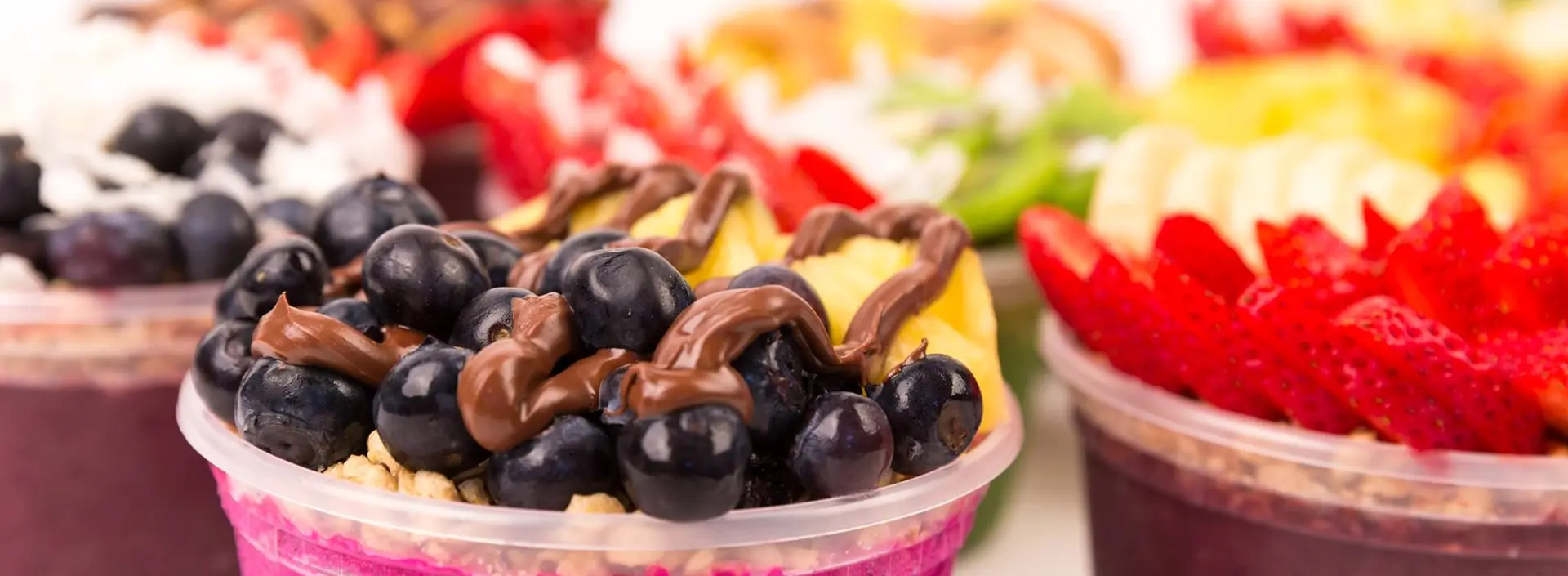
Pitaya (dragon fruit) is bright magenta, noticeably lighter than açaí, and mildly sweet with a texture closer to a kiwi-melon cross. It blends thinner than açaí, so pitaya bowls tend to eat lighter. If açaí feels too rich first thing in the morning, pitaya is usually the answer. Our Island Bowl leans into that with kiwi, pineapple and coconut flakes.
Green bases built on spinach blended with fruit juice give you the vegetable without the vegetable flavor — the fruit carries it. These are the lightest of the three and the most common choice for people who want something after a workout rather than instead of dessert. The Hulk is the straightforward version: spinach, apple juice, banana, pineapple, peanut butter and cacao nibs.
Thickness is the real dividing line
If you take away one thing, make it this: the difference between a smoothie and a smoothie bowl is liquid ratio, and it is not a small difference.
A drinkable smoothie needs to move through a straw. A bowl needs to hold a spoon and support toppings without turning them into sludge. That means substantially less liquid and more frozen fruit — which is also why a bowl generally has more actual fruit in it than a smoothie of the same volume.
It is also why a bowl gets worse the longer it sits. The texture is the point, and it is temperature-dependent. Eat it there.
Toppings are not decoration
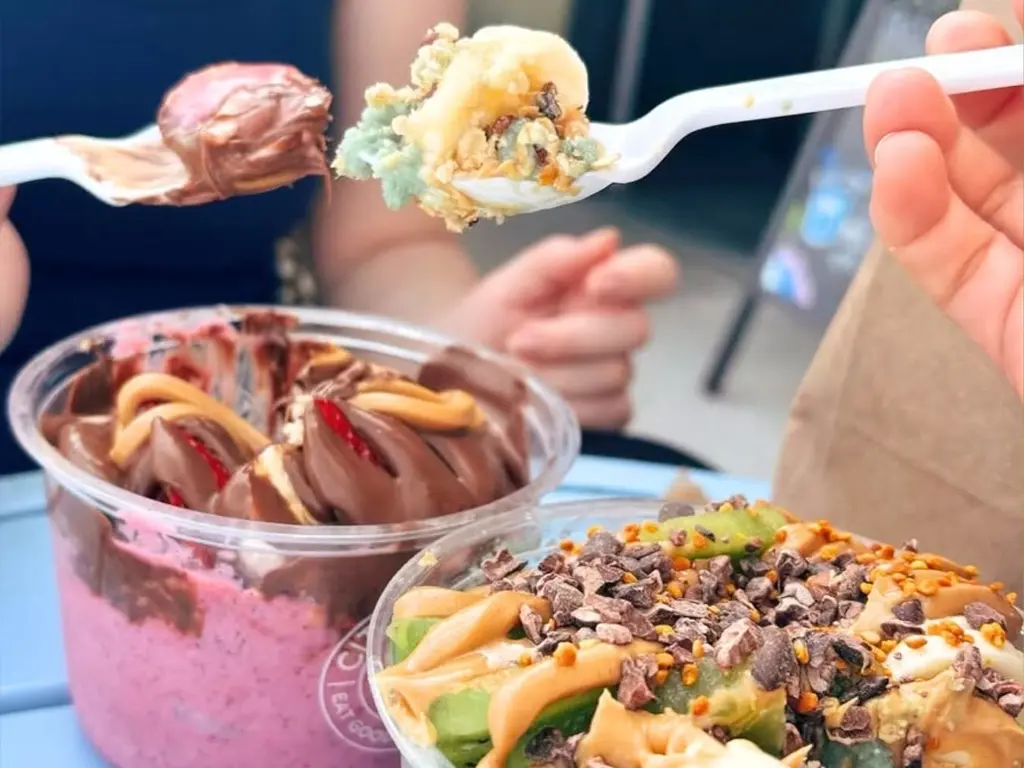
On a drinkable smoothie, toppings are impossible. On a bowl, they are half the reason to order one — and they are where most of the texture contrast lives.
The usual categories:
- Granola — the structural crunch. Almost every bowl has it.
- Fresh fruit — strawberries, banana, blueberries, kiwi, mango, pineapple.
- Nut butters — peanut butter or Nutella, for richness and staying power.
- Seeds and superfoods — chia, bee pollen, goji berries, cacao nibs.
- Coconut flakes — chew and aroma without much sweetness.
- Honey drizzle — the finisher.
A well-built bowl balances these rather than piling them on. You want something crunchy, something fresh, and something rich in every few bites.
So which one should you order?
A rough guide:
Order açaí if you want the richest option, you are eating it as a meal rather than a snack, or you like dark chocolate and berry flavors. Start with the OG Bowl — açaí, apple juice, banana, strawberries, granola, honey drizzle. It is the baseline for a reason.
Order pitaya if açaí feels heavy, you want something brighter, or you are eating in the afternoon rather than the morning.
Order green if you are coming from the gym, you want the lightest option, or you are trying to get vegetables into your day without thinking about it.
Add protein to any of them if the bowl is replacing a meal. Without it, a fruit bowl will not hold you as long as you expect.
Come try the difference
Every City Bowls location makes bowls to order across all three bases, so the easiest way to settle the açaí-versus-pitaya question is to taste them next to each other.
Have a look at the full menu, then find your nearest shop — we have eight across Alabama, from Downtown Birmingham and Homewood to Huntsville and Tuscaloosa.